Saturday, June 11, 2011

Does Ants have fungus on brain.


Tropical carpenter ants (Camponotus Leonardo) live high up in the rainforest canopy. When infected by a parasitic fungus (Ophiocordyceps unilateralis) the behavior of the ants is dramatically changed. They become erratic and zombie-like, and are manipulated by the fungus into dying at a spot that provides optimal conditions for fungal reproduction. New research, published in Biomed Central's open access journal BMC Ecology, looks at altered behavior patterns in Zombie ants in Thailand and shows how the fungus manipulates ant behavior.

A multinational team of scientists investigated O. unilateralis infected carpenter ants in Thailand's rainforest. The growing fungus fills the ant's body and head causing muscles to atrophy and forcing muscle fibers apart. The fungus also affects the ant's central nervous system and while normal worker ants rarely left the trail, zombie ants walked in a random manner, unable to find their way home.


The ants also suffered convulsions which caused them to fall to the ground. Once on the ground the ants were unable to find their way back to the canopy and remained at a lower, leafy, 'understory' which, at about 25cm above the soil was cooler and moister than the canopy, provided ideal conditions for the fungus to thrive.........

Wednesday, June 8, 2011

C@@l pics Of Animals


World's largest bird-Shoebill


Balaeniceps rex, also known as Whale head, is a very large bird related to the storks. It derives its name from its massive shoe-shaped bill.
The Shoebill is a very large bird, averaging 1.2 meters tall, 5.6 kilograms and a 2.33 meters wingspan. The adult is mainly grey while the juveniles are browner. It lives in tropical east Africa in large swamps from Sudan to Zambia.


This species was only discovered in the 19th century when some skins were brought to Europe. It was not until years later that live specimens reached the scientific community. However, the bird was known to both ancient Egyptians and Arabs. There are Egyptian images depicting the Shoe bill, while the Arabs referred to the bird as abu markub, which means one with a shoe, a reference to the bird’s distinctive bill.


Shoe bills feed in muddy waters, preying on lungfish and similar fish. They nest on the ground and lay 2 eggs.The population is estimated at between 5,000 and 8,000 individuals, the majority of which live in Sudan.

Thursday, June 2, 2011

Okapi- A Rain forest Animal's Fact

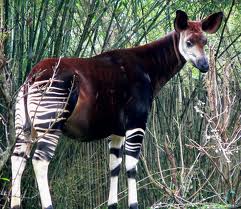
The okapi is one of the last remaining ancestors of the common giraffe, despite the fact that the striking markings of the okapi give the okapi can almost zebra like appearance.The okapi is native to the Ituri Rain forest, a 63,000 square kilometer rain forest that is located in the Democratic Republic of the Congo, in the North East Africa. Around a fifth of the rain forest is made up of the Okapi Wildlife Reserve, which is a World Heritage Site.

The okapi is a herbivorous animal that spends its time rummaging for tasty treats to munch on. The okapi eats more than 100 different types of plant includes leaves, grasses, buds, shoots, fruits and even fungi. Many of the plants that the okapi feed on would be poisonous if ingested by humans.


The okapi has a red-brown colored coat of fur with horizontal white striped markings, that are found on the legs of the okapi. The okapi develop these extraordinary markings at a young age, as the white stripes of the okapi are thought to give the okapi good camouflage from predators in the dense African jungle.

The main predator of the okapi is the leopard, an animal that spends a lot of time resting in the trees and surveying the surrounding area for potential prey. Other predators of the okapi include wildcats such as the serval, and the human hunters in the area.


The okapi has large ears which enables the okapi to detect approaching predators with enough time for the okapi to get away and hide. The okapi also has an impressively long tongue, with the okapi being one of the few animals in the world that is able to lick its own ear!

Okapi are active during the day meaning that the okapi is diurnal. The okapi spend their waking hours foraging for food. As well as the plants that the okapi eat, they also eat a reddish clay that provides essential salt and minerals to the plant based diet of the okapi.Okapi are generally not sociable animals and okapi do not seek companionship. However okapi may occasionally feed together in small groups for a short period of time. Okapi prefer to live alone in large, secluded areas.

Male and female okapi come together briefly to mate, then go their separate ways. Female okapi take themselves deep into the forest to give birth to their young. A mother okapi usually gives birth to one baby okapi at a time, and this baby okapi will remain hidden in the nest of foliage for the first couple of months. The mother okapi return to the baby okapi to allow it to nurse and she will then wean her offspring at about 6 months of age. However, the baby okapi will not reach full size until it is about 3 years old.

Wednesday, June 1, 2011

Crustaceans Facts...


Crustaceans are a type of Arthropod. The name may not sound familiar, but you probably know them. You may even have eaten one.

Crustaceans live mostly in the ocean or other waters. Most commonly known crustaceans are the crab, lobster and barnacle.

Crustaceans have a hard, external shell which protects their body. Crustaceans have a head and abdomen. The head has antennae which are part of their sensory system. The abdomen includes the heart, digestive system and reproductive system.


The abdomen also has appendages, such as legs, for crawling and swimming. Many crustaceans also have claws that help with crawling and eating.