Sunday, November 13, 2011

Bears leave hairless at Zoo expert bewildered

A spectacled bear name Dolores (pictured) is fairs an unconventional look after losing approximately all her hair.

Since 2007 the female spectacled bear and two of her female kin at Germany's Zoo Leipzig have been going hairless—mysterious experts. Zoo experts are operational to cure the bears' non-life-threatening condition, zoo curator


Spectacled bears—also called Andean bears—live in the mountains of South America and are the continent's only bear species. Armando Castellano, leader of the Andean Bear Conservation Project in Ecuador, said that he'd seen a similar case about a decade ago in a rescue spectacled bear.

"We were very scared, because it was the primary time we had seen this," Castellano said.

Keepers in Ecuador place that bear, which had before been fed human food—counting Coca-Cola—on its usual diet of fruits and bamboo, and added enhancement items, such as toys and exotic foods, into the bear's enclosure. Four months later the fur grew back.

Alike cases have occur in a Bolivian zoo and in Peru, Ximena Velez-Liendo, a spectacled bear specialist, said by email. It’s unidentified whether a be short of of nutrition is the culprit in the Leipzig bears' situation. awaiting a cure is found, keepers have been applying medical ointment to the bears' skin, which becomes itchy without its defensive fur.

Thursday, November 10, 2011

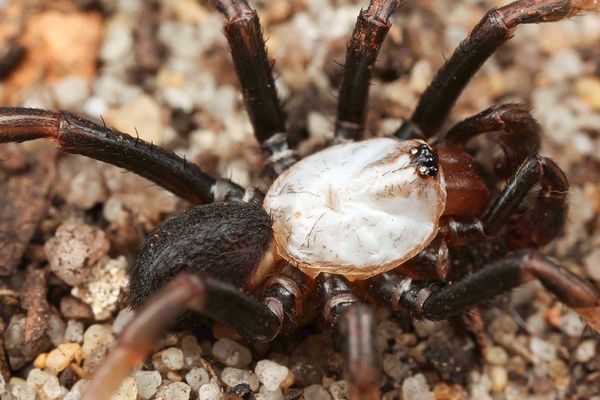
Innovative "Albino" Spider establish in Australia


The new found trapdoor spider isn't a factual albino, since it motionless has some pigment—its body is brown, similar to those of other trapdoor spiders.But the 1.2-inch-wide (3-centimeter-wide) arachnid has been dubbed the albino trapdoor spider until it does officially describe as a new species.

People in a small town in Western Australia establish the strange-looking spider close to his house, captured it in a jar, and sent it to the museum.

"Unluckily we know nothing about its life history. We assume that they live in burrows for their whole lives—like all trapdoor spiders—and when males mature, they stroll in search of females in their burrows," .

Trapdoor spiders get their name since they use soil, vegetation, and silk to build doors to their burrows that are hinged with silk. The arachnids then pop out when they sense the feelings of passing prey, which include insects, other arthropods, and small invertebrates. The spiders also mate inside the burrows, where "males of all species almost certainly have to lift the female body up to access her genital opening, which is located on the underside of the abdomen,".

The newfound spider is careful rare, Harvey added—it's currently the only known specimen of its kind."Spiders are a varied group of animals that fascinate and terrify many people," though they're crucial in keeping insect populations in check."The world would be a poorer place without spiders."

Monday, November 7, 2011

Bizarre Life Found In deep Ocean


Scientists plumb the lowest point of the Mariana Trench -- the sincere part of the ocean on the planet -- have recognized gigantic amoebas lurk miles and miles beneath the waters.

The creatures are called xenophyophores, and scientists from the Scripps Institute of Oceanography at UC San Diego spotted them in the cold, crushing depths 6.6 miles under the white caps.

"They are charming giants that are extremely adapted to extreme circumstances but at the same time are very fragile and poorly studied”.


Scripps scientists said xenophyophores are in the middle of the main person cells in existence, often growing longer than four inches. Recent studies indicate that by trapping particles from the water, xenophyophores can concentrate high levels of lead, uranium and mercury and are thus likely highly resistant to large doses of heavy metals. They also are well suited to a life of darkness, low temperature and high pressure in the deep sea."The identification of these gigantic cells in one of the deepest marine environments on the planet opens up a whole new habitat for further study of biodiversity ... and extreme environment adaptation,"

To reach the bottom of the ocean requires special equipment. Levin worked with Eric Berkenpas and Graham Wilhelm -- Remote Imaging engineers from the National Geographic Society -- to build and launch "drop cams."

"Drop cams are versatile autonomous underwater cameras containing an HD camera and lighting inside of a glass bubble," Berkenpas explained. By wrapping high-resolution cameras in a thick-walled glass sphere, scientists were able to drop cameras capable of withstanding the extreme pressure of all that ocean. At a depth of 6.6 miles, the water above can cause more than eight tons per square inch of pressure.

Life is surprisingly abundant at these extreme depths, despite the cold and pressure. According to Dhugal Lindsay of the Japan Agency for Marine-Earth Science and Technology, the Dropcam movie also depicts the deepest jellyfish observed to date.

Tuesday, November 1, 2011

Best pics

Galápagos Tortoise in addition to infant


A Galápagos tortoise dwarfs her baby in this photo released in October by the Taronga Western Plains Zoo in New South Wales, Australia.

The hatchling weighs roughly 3 ounces (87 grams) at birth. It will take 30 ears for the baby to reach a similar girth as its mother—a huge 564 pounds (256 kilograms).

Galápagos tortoises are the longest-lived of all vertebrates, with regular lifespans of more than a hundred years.

Monday, October 31, 2011

Hooded Seal Facts

The Hooded Seal (Cystophora cristata) is an arctic seal also recognized as Crested Seal. Belong to the family Phocidae, it can only be found within North Atlantic central and western regions from Svalbard to the Gulf of St. Lawrence, all through the northern areas of Atlantic Ocean, in part near Labrador, and in northeastern Newfoundland down to New England. It lives on ice packs and in the Atlantic Ocean's deep waters.

The Hooded seal is known for and named as such due to the 'hood' of the male, a sole and strange addition that can be inflated to what resembles a red balloon. This appendage hangs from the forehead to the mouth's front and bulges out when the male is either threatened or excited. It is most characteristic, though, when it is mating. Its head is black, and its fur is silvery or grayish with a prototype of dark clouded spots. The front flippers have large claws and darker color than the body. The male is usually 2.6 meters in length and about 400 kilograms in weight while the female is smaller at 2.03 meters and about 300 kilograms on the average.

The hooded seal's most visible and most peculiar behavior still pertains to the male's 'bulge'. It balloons to about twice the size of a football when the male blows it up by closing one of its nostrils. The trunk becomes bigger especially when the male is mating. The hood forms at first in young males that are about 4 years. It become fully developed by the time he reaches 12 years. The bulge size varies according to individual body size although the standard size is around 6.3 liters.


The hooded seal lives alone usually but converges in big groups during mating and reproductive season. This seal species has the shortest period for lactation in the middle of all mammals at four existence only. Feeding mainly on deepwater fish like redfish, herring, Greenland turbot, cod, capelin, flounder, halibut, squid, octopus, shrimp, and mussels, a hooded seal can live as long as 30 to 35 years.

Sunday, October 23, 2011

Snail Surfer


A feminine violet snail, Janthina exigua, hangs from a float of home-based mucus.

Scientists have extended observed snails "surfing" the load on such rafts, which can dish up as flotation devices, egg-storage areas, and platform for youthful snails.

But it was unknown how the family of fewer than ten bubble-rafting species evolved their odd lifestyles, said Celia Churchill, a Ph.D. student at the University of Michigan in Ann Arbor.


Churchill had already supposed that bubble rafters evolve from bottom-dwelling snails that create mucus-filled egg masses. To pinpoint the rafting snails' neighboring relatives, the team sequenced DNA from bubble-rafting class and other possible "sister families," using molecular technique to piece jointly an ancestral family tree.

The results exposed that bubble rafters descend from a bottom-dwelling snail call the wentletrap, which still exists today.

Both snail groups exude mucus from their feet-muscular organs at the basis of their bodies. But in its place of making egg masses, the bubble rafters use the quick-hardening mucus to make rafts with the "consistency of bubble wrap,", whose new study appeared recently in the journal Current Biology.

Thursday, October 13, 2011

frill-necked lizard,

Frill-necked Lizard
Kingdom: Animalia
Phylum: Chordata
Class: Sauropsida
Order: Squamata
Family: Agamidae
Genus: Chlamydosaurus
Species: Chlamydosaurus kingii
Common Name: Frill-necked lizard,frilled dragon,bicycle lizard


The frill-necked lizard, which belongs to the agamid family, can be mostly established in northern Australia and southern New Guinea. Its name derives from the large frill surrounding its neck. The frill necked lizard stays folded for most of the time, though whenever this strange animal is in danger it opens up its mouth and the frill folds out. By responsibility this lizard seem better and scarier to its potential predators. If this fail, the lizard has one more defense mechanism to empoy , its speed. The frilled dragon is very fast and can even "sprint" on its two hind legs. in fact the way it runs is very funny and is the cause this lizard is also called "bicycle lizard" .


The frill-necked lizard is one of the largest lizards in existence. The males can reach up to almost a metre in total length, with females being significantly smaller in size.

Frill-necked lizards are characteristically insectivorous, and their diet consists of cicadas, beetles, temites, butterflies and moths. They also eat spiders, other lizards and some times small mammalls.